Hollywood has reinvented itself many times. Sound transformed silent film. Television changed the economics of entertainment. Streaming rewrote distribution. Now artificial intelligence may be setting the stage for another transformation, one that could alter not only how entertainment is produced, but who has the ability to produce it.
Veteran film and television producer Kirk Shaw, CEO of Ambitious Entertainment, believes Hollywood is entering what could become a new era led by creators.
“I believe the last decade belonged to the influencer. The next decade will belong to the creator.”
It is a notable perspective from someone whose career was built largely inside the traditional entertainment system.
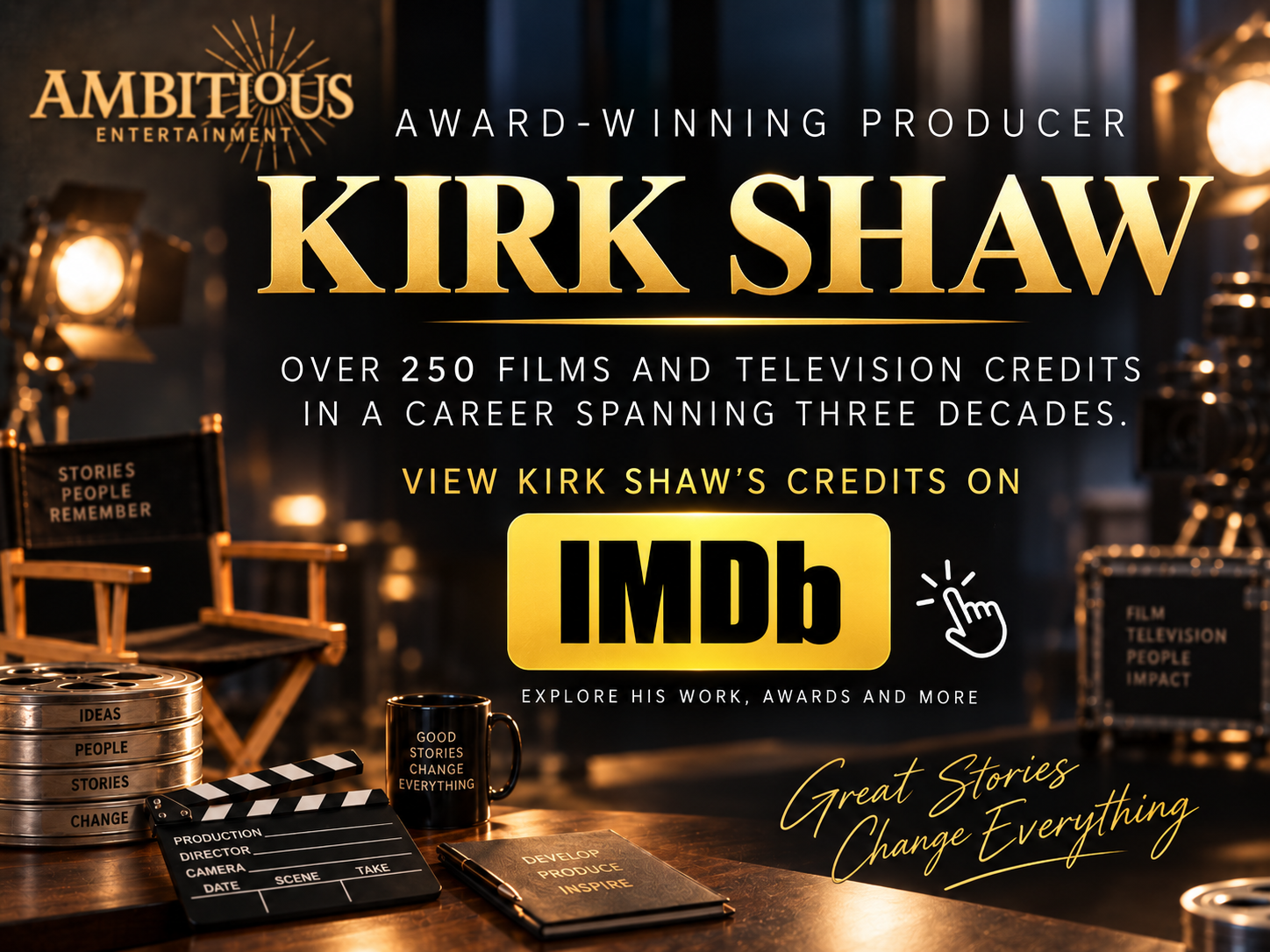
Shaw has spent approximately three decades producing film and television, with more than 250 films and seven television series to his credit. His career has included work with major studios and talent including Charlize Theron, Woody Harrelson, Kim Basinger, John Travolta, Nicolas Cage, Jean Claude Van Damme and Bruce Willis. He also had producing involvement with the Academy Award winning film The Hurt Locker.
That experience gives Shaw a clear view of the resources traditionally required to bring a professional production from an idea to an audience. It also helps explain why he believes artificial intelligence could reshape the balance of power within entertainment.
AI Could Change the Economics of Storytelling
For generations, producing professional entertainment has required access to substantial capital, specialized equipment, experienced production crews, post production facilities and established distribution relationships.
Those barriers helped determine which stories reached audiences and which never progressed beyond a screenplay, pitch or idea.
Artificial intelligence has the potential to compress portions of that process.
Tools capable of assisting with writing, visualization, editing, production, audio, visual effects and other creative functions could allow much smaller teams to accomplish work that once required considerably larger organizations.
The result could be a meaningful change in the economics of storytelling.
A creator who once needed a studio, a large crew and significant financing may increasingly be able to develop a concept with a compact team. Early ideas can be visualized before costly production begins. Scenes can be tested, revised and refined more quickly. Editing, sound design and effects can become accessible to people who previously lacked the money or industry relationships required to use them.
Not every part of filmmaking can or should be automated. Production remains a deeply collaborative process built around judgment, taste, performance and human experience. But reducing the cost and complexity of certain tasks could allow more people to participate.
Shaw views that transformation less as a threat to Hollywood than as an expansion of who can enter it.
Creators may increasingly be able to develop, produce and distribute stories from a basement, garage or kitchen table while reaching audiences around the world without first receiving permission from traditional industry gatekeepers.
That distinction could ultimately prove more important than any individual AI tool.
The real disruption may not be that artificial intelligence makes existing Hollywood productions less expensive. It may be that professional quality storytelling becomes accessible to dramatically more people.
From the Influencer Economy to the Creator Economy
The social media era demonstrated the power of removing distribution barriers.
YouTube, Instagram, TikTok and other platforms made it possible for individuals to reach millions of people without owning a television network, publishing company or movie studio.
But distribution was only part of the equation.
Creators gained direct access to audiences, yet many still faced the same production limitations that had defined entertainment for decades. They could publish instantly, but producing ambitious scripted work still demanded time, money, equipment and specialized labor.
Artificial intelligence could begin removing barriers on the production side as well.
The influencer era gave individuals access to audiences. The AI creator era could give those same individuals access to increasingly sophisticated production capabilities.
That combination could create an entirely different entertainment ecosystem. Creators would do more than accumulate followers or promote products. They could build characters, stories, franchises and intellectual property capable of becoming sustainable businesses.
Instead of waiting for a studio to finance an idea, creators could begin proving that idea themselves. They could produce an early episode, visualize a larger world or test whether an audience connects with a character. Audience response could become part of development rather than something measured only after a major investment has already been made.
This would not necessarily eliminate studios, producers or distributors. It could change when and how those organizations become involved. A studio might encounter a creator after that person has already established an audience, demonstrated demand and built the foundation of an original property.
As Shaw puts it, “That’s the future I want to be associated with: helping creators build valuable intellectual property and sustainable businesses around their ideas.”
He describes the moment as the potential birth of “a completely new entertainment ecosystem.”
Ownership May Become the Defining Question
The shift Shaw describes is about more than production efficiency. It is also about ownership.
Influencers often built large audiences on platforms they did not control. Their reach could be affected by changing algorithms, advertising policies or platform priorities. While that model created opportunities, it also left many creators dependent on systems owned by someone else.
Original intellectual property offers a different path.
A memorable character, story world or franchise can move across formats and platforms. It can begin as a short mobile series, expand into longer episodes, inspire merchandise or develop into a feature film. The creator is no longer only the face of a channel. The creator becomes the owner of an entertainment asset.
Artificial intelligence could make it easier to begin that process. A creator may be able to test several concepts, develop visual identities and produce early material without committing the budget normally associated with a conventional production.
The strongest ideas could then grow in response to real audience interest.
For creators, that creates the possibility of building lasting value rather than depending entirely on sponsorships, advertising revenue or temporary visibility.
For the entertainment industry, it could create a much larger and more diverse pipeline of proven stories.
Micro Dramas May Offer an Early Look at What Comes Next
One area Shaw believes is particularly well suited to this transition is the emerging micro drama market. These short scripted productions are created primarily for mobile audiences and often presented vertically for smartphone viewing.
The format sits at an interesting intersection between traditional Hollywood storytelling and the viewing habits developed through social media.
Unlike conventional television episodes or feature films, micro dramas can be produced and consumed in short installments optimized for mobile devices. Successful productions in the category have generated audiences exceeding 100 million views.
Their structure also encourages frequent storytelling decisions. Each installment must capture attention quickly, move the narrative forward and give the viewer a reason to continue. The format borrows the momentum of serialized television while adapting it to the speed and convenience of mobile media.
Artificial intelligence could make that model even more scalable.
AI can potentially be incorporated throughout portions of the production workflow to reduce costs, accelerate production and allow creators to experiment with more concepts without assuming the financial risk associated with a conventional studio production.
A small team might use AI tools to explore locations, create early storyboards, test visual approaches, assist with editing or prepare versions for different audiences. Those efficiencies could make it possible to produce more ambitious work on smaller budgets.
That makes micro drama more than another entertainment format. It may become a testing ground for a much broader question.
What happens when cinematic storytelling becomes as accessible as social media publishing?
If creators can combine direct audience access with affordable production capabilities, the line between social media personality, independent filmmaker and entertainment company may begin to disappear.
Hollywood Still Needs What Technology Cannot Replace
There is an irony at the center of Hollywood’s AI debate.
Technology may dramatically change the mechanics of filmmaking, but the industry’s most valuable commodity remains remarkably traditional: a compelling story.
AI can provide creators with new capabilities. It can potentially make production faster, less expensive and more accessible. It can help translate an idea into images, sound and eventually finished entertainment.
But technology alone does not give an audience a reason to care.
Characters still have to matter. Stories still need emotion. Creators still need a point of view.
Audiences remember how a story made them feel, not which software was used to make it. They return to characters they recognize, conflicts they understand and worlds they want to revisit. No increase in production speed can replace those fundamentals.
For Shaw, whose own entry into the film business was rooted in writing, that distinction remains important. His career has reinforced the value of storytelling even as the economics and technology surrounding it continue to evolve.
The creators most likely to benefit from AI may not be those who generate the largest volume of content. They may be those who use new tools in service of a clear creative vision.
That may ultimately define AI’s role in Hollywood.
The most significant change may not be machines replacing creativity. It may be technology giving significantly more creative people the ability to compete.
A Wider Door Into Entertainment
Hollywood’s next generation of filmmakers may still emerge from studios, film schools and production companies.
But they may also emerge from bedrooms, garages, small creative teams and independent businesses located thousands of miles from Los Angeles.
A filmmaker no longer has to live near a studio lot to begin building a visual world. A writer does not necessarily have to wait for a producer to imagine how a scene might look. A small team may be able to present a concept with a level of polish that once required resources far beyond its reach.
Greater access will also mean greater competition. When more people can produce credible work, audiences will have more choices and creators will face more pressure to distinguish themselves. Technical quality alone will not be enough.
Voice, originality and emotional connection may become even more valuable.
Traditional Hollywood will continue to possess major advantages, including financing, experienced talent, marketing power and global distribution. AI does not erase those strengths. It does, however, give independent creators new ways to develop ideas, demonstrate demand and arrive at the negotiating table with more than a pitch.
The gates surrounding professional entertainment are beginning to move.
If Shaw’s prediction proves correct, the defining entertainment story of the next decade may not simply be the rise of artificial intelligence.
It may be the rise of the creator.